
Saskatchewan · First park road trip
Grasslands National Park Road Trip Guide
Grasslands asks for a different kind of road-trip confidence: fewer services, more sky, two separate park blocks and roads that can change after rain. Choose one block and arrive prepared to slow down.
- Region
- Grasslands National Park, southern Saskatchewan
- Best for
- First-time prairie visitors, families and road-trippers travelling through southern Saskatchewan
- Season
- Year-round landscape; most visitor services and self-guided offers operate seasonally
- Time
- Two to three nights in one block
By Horizon Outdoor Editorial TeamPublished 2026-09-10
Quick facts
- First decision
- West Block or East Block, not both by default
- Road reality
- Gravel access and park roads may be impassable when wet
- Navigation
- Official directions and offline map; GPS can be wrong
- Core supplies
- Fuel margin, drinking water, food, layers and emergency kit
Choose the West Block or East Block before choosing the route
Grasslands National Park has two separate blocks with different access, landscapes, campgrounds and visitor reception points. They are not adjoining halves of one scenic loop. For a short first trip, choose the block that matches the group’s main interest and build the entire stay around its official directions and map.
The West Block connects with Val Marie, prairie wildlife and the Ecotour Scenic Drive; the East Block offers a different badlands and fossil landscape around Rock Creek. Confirm current activities and services before assigning either identity too narrowly. Visiting one block well is more useful than spending most of the trip transferring between them.
- Compare both block maps and current services
- Select one block for a two- or three-night visit
- Save the exact official approach directions offline
Let rain decide whether the park road is drivable
Park access is by gravel road, and Parks Canada warns that roads inside the park—including campground approaches—may become impassable when wet. Check with park staff and review the Saskatchewan Highway Hotline before the final approach. A vehicle type does not override a closure, muddy surface or local instruction.
Use the signed route rather than a shortcut suggested by a navigation app. Drive slowly, remain on authorised roads and do not enter a drive-through-only area expecting to stop or hike. If conditions deteriorate, stay in the community or use an official paved-road alternative until the park confirms access.
- Check park staff information and the Highway Hotline
- Follow signed access instead of an unverified GPS shortcut
- Turn back before a wet gravel road becomes a recovery problem
Carry what the distance between services requires
Fuel up before the park approach and carry a comfortable reserve. Cell service is intermittent, so keep offline maps, emergency contacts and a shared return plan. Bring food, more drinking water than an urban day would require, sun protection, warm layers and a vehicle emergency kit suited to the season.
Surface water is not a dependable drinking source. Heat, dry wind and sudden storms can all shape the same day, while shade may be limited. Place the main activity in the more comfortable part of the forecast and reduce distance when temperature or lightning risk rises.
- Fuel early and avoid planning around a nearly empty tank
- Carry offline navigation and a shared trip plan
- Bring ample treated drinking water and weather protection
Make wildlife observation a distance skill
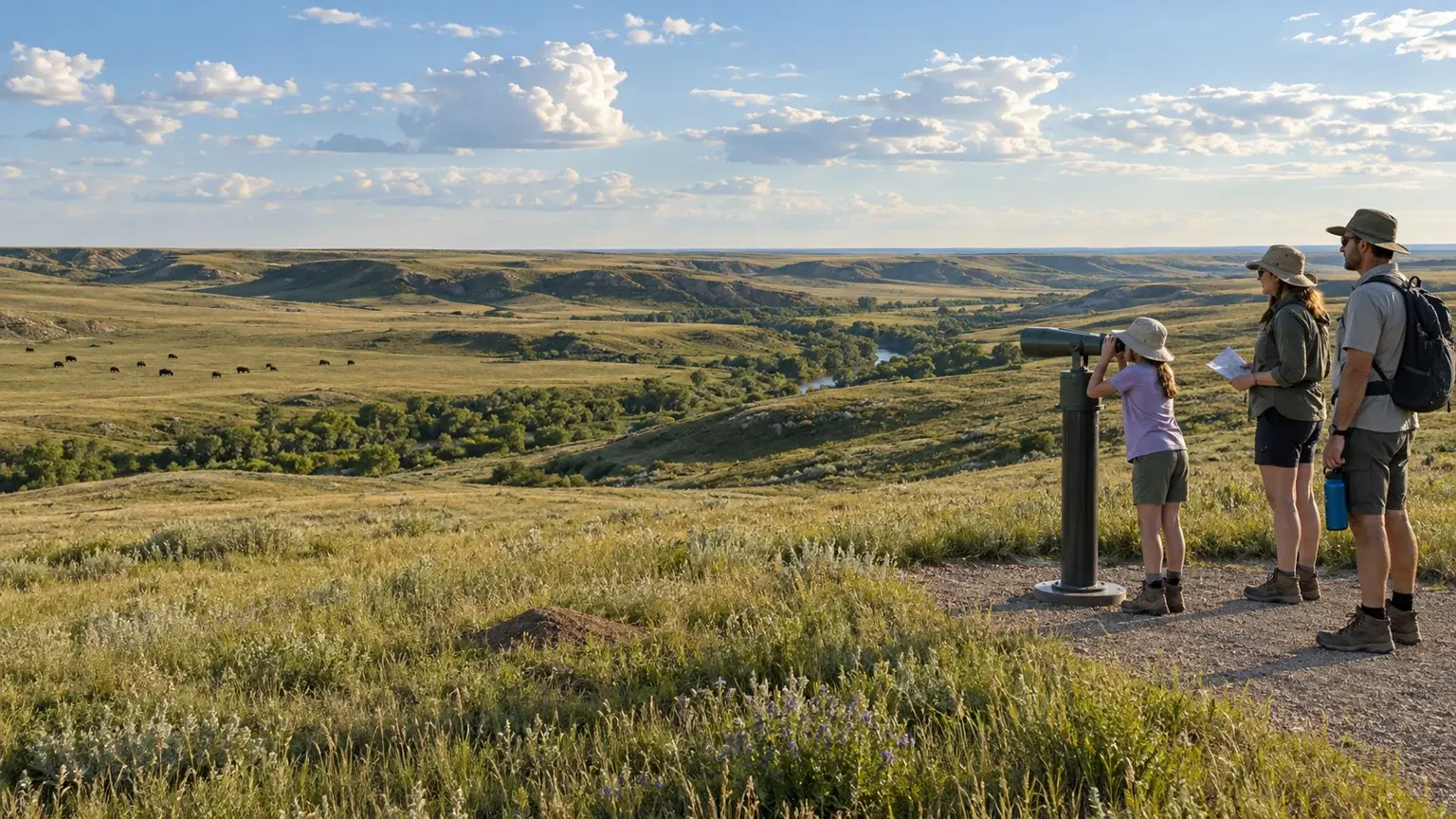
Bison, prairie dogs, rattlesnakes and other prairie species require different awareness. Follow the current distances and instructions in the park trail guide, use fixed spotting scopes or binoculars and keep the group together. If bison occupy a scenic drive, remain in the vehicle and proceed only as directed and safe.
Stay out of prairie-dog colonies with pets, keep dogs leashed and never feed or approach wildlife. Watch where hands and feet are placed around rocks, shrubs and burrows. Wildlife is not an obstacle between the group and a photograph; its space determines where the group stops.
- Use optics instead of approaching
- Remain in the vehicle around bison on the drive
- Keep pets leashed and away from prairie-dog colonies
Build a small daylight plan before adding dark sky
Choose one self-guided drive or marked trail and leave time for visitor-centre interpretation. Note the turnaround, road surface and remaining daylight before continuing. Backcountry routes require separate navigation and camping preparation; they should not appear spontaneously at the end of a road-trip day.
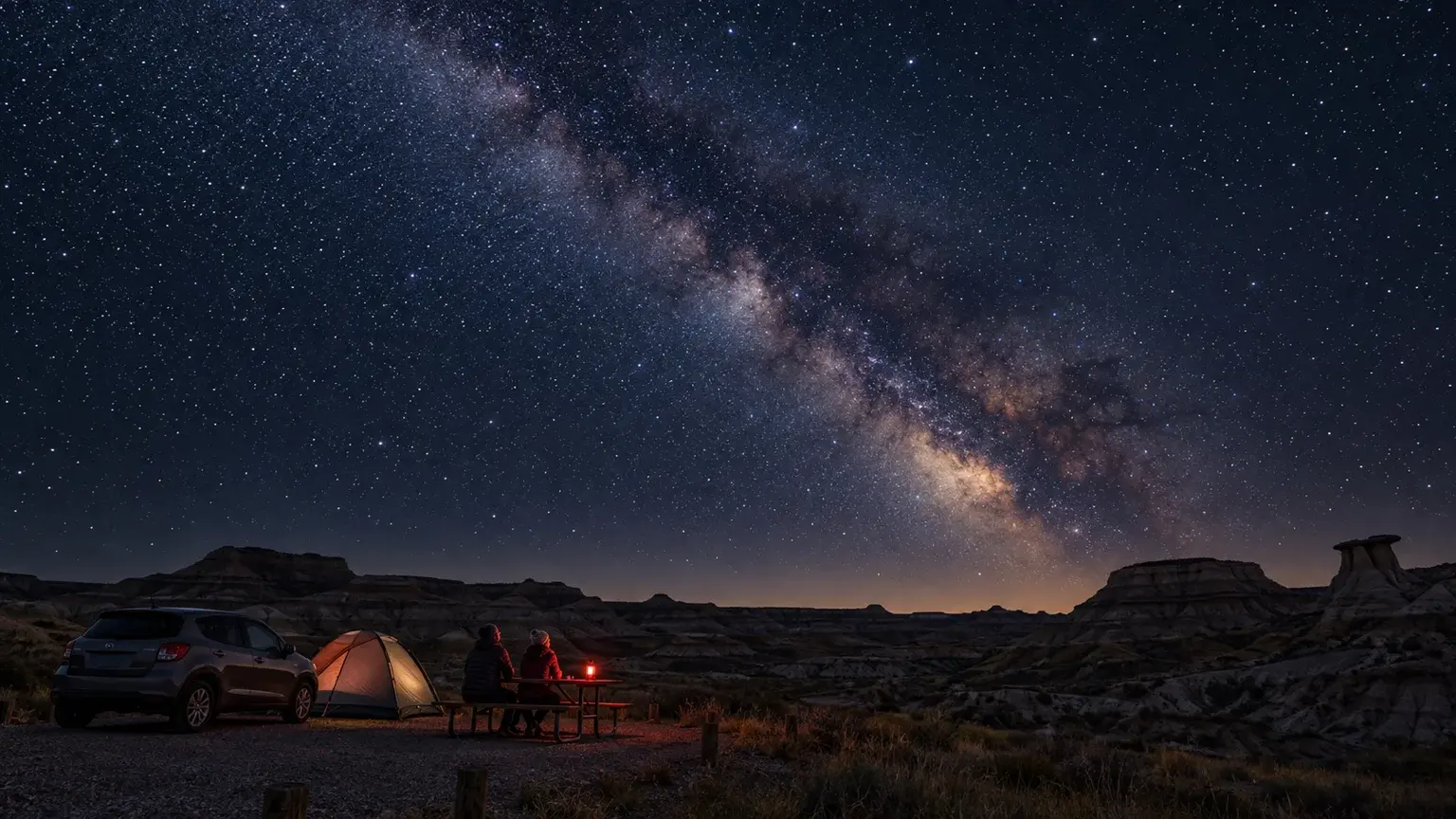
Dark-sky viewing can be a memorable second chapter, but it needs a legal campsite or designated setting, warm layers, red light and a known route back. Camping is allowed only in designated or properly authorised locations. Do not sleep in a roadside pullout, trailhead or day-use area.
- Complete one daylight orientation before staying after dark
- Use a reserved or authorised overnight location
- Keep navigation, warm layers and a red light ready
Common planning mistakes
- Treating East and West blocks as a single short loop
- Following an unverified GPS shortcut on rural gravel roads
- Entering wet park roads because the vehicle has four-wheel drive
- Approaching bison or prairie dogs for a closer photograph
- Sleeping at a trailhead or pullout instead of an authorised campsite
Printable companion
Download the Canada road trip checklist
A printable list for documents, driving, weather layers, park days and the essentials worth keeping within reach.
Download the free PDFQuestions travellers ask
Which Grasslands block should a first trip choose?
Choose according to the current activities and landscape your group values most. For a short visit, one block prevents a long transfer from consuming the trip.
Do we need a four-wheel-drive vehicle?
Vehicle requirements depend on the exact route and conditions. No vehicle makes an impassable or closed wet road appropriate; ask park staff and obey current guidance.
Can we rely on phone navigation?
No. Parks Canada warns that GPS directions may be wrong and cell service is intermittent. Save the official block map and approach directions offline.
How should families observe bison?
Use the current park distance guidance, binoculars or spotting scopes. Stay in the vehicle if bison are encountered along the scenic drive and never approach for a photograph.
Sources and currency
Conditions change. Confirm dynamic details again before departure; each source shows its own last-checked date.
- Parks Canada: Planning ahead for Grasslands National Park (2026-09-10)
- Parks Canada: Grasslands park maps and navigation guidance (2026-09-10)
- Parks Canada: Grasslands facilities and visitor services (2026-09-10)
- Parks Canada: Grasslands brochures and publications (2026-09-10)
- Parks Canada: Grasslands National Park trail guide (2026-09-10)
- Parks Canada: Black-tailed prairie dogs in Grasslands (2026-09-10)
- Parks Canada: Grasslands visitor guidelines (2026-09-10)
- Parks Canada: Parks Canada reservations (2026-09-10)
- Government of Saskatchewan: Saskatchewan Highway Hotline (2026-09-10)
- Environment and Climate Change Canada: Canadian weather forecasts and alerts (2026-09-10)
Continue planning
Related field guides
Alberta–Saskatchewan · Prairie route
Prairie Badlands Road Trip Guide
Canada’s prairie badlands are not one continuous attraction. The Drumheller valley, Dinosaur Provincial Park and Grasslands National Park each deserve their own base and access plan, with open-country transfers treated as part of the journey.
Open the guide
Winnipeg · Prairie outdoor living
Prairie Outdoor Weekends from Winnipeg
Prairie outdoor life is shaped as much by sky, wind, water and seasonal surfaces as by distance. Start with Winnipeg’s trails and natural areas, learn what exposure means for the group, and widen the radius only when a provincial park adds the day you want.
Open the guide
Printable planning guide
Canada Road Trip Packing Checklist
Start with the essentials that protect the trip, then remove anything your route, season and travelling party do not need.
Open the guide